April Reflections: Memory, Exam Stress & Why Minds Go Blank
The book I’ve been living with this month: Moonwalking with Einstein
As April draws to a close…
Colour is blooming everywhere, lighter evenings are giving us the first real hints of summer… and exam season is starting to hover in the background.
Revision books are appearing on kitchen tables, bedroom doors may be staying closed a little longer than usual, and “I’m fine” is being said in homes everywhere… whether it’s true or not.
This month’s book caught my eye before I’d even opened it. Moonwalking with Einstein.
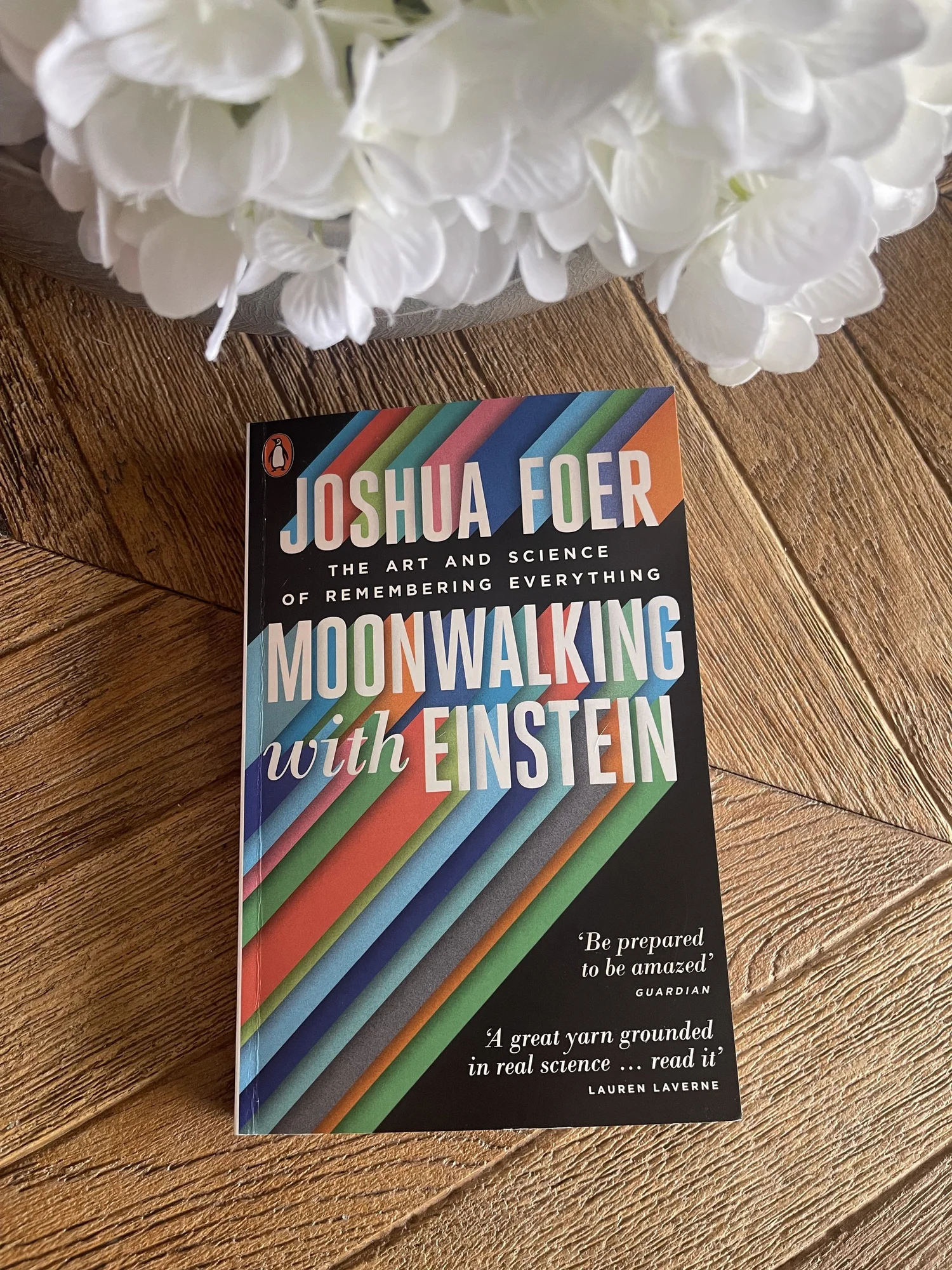
Honestly… who wouldn’t want to know more?
The title alone deserved a look.
It follows journalist Joshua Foer, who becomes fascinated by the world of memory competitions and decides to see whether an ordinary brain, with the right training, can do extraordinary things.
And as someone whose memory has always felt a little selective, I was instantly intrigued.
Partly because of the exam-season timing.
Partly because I’m dyslexic, and I’ve never really followed the most conventional route when it comes to learning or remembering things.
And partly because I’ve always found memory fascinating.
Why memory can feel so strange
How I could never reliably hold onto my times tables.
How many c’s or s’s there are in the word necessary still feels unnecessarily frustrating.
And yet song lyrics from twenty years ago can return instantly when the first note plays.
How I can remember where someone was sitting, what they were wearing, and sometimes repeat a conversation almost word for word years later.
I can even still recite chunks of Hamlet’s soliloquy… but might need a moment to remember where I left my phone five minutes ago.
Brains are funny like that.
And perhaps a little more trainable than many of us realise.
It reminded me of something I often come back to in sessions… how memory actually works.
It’s easy to assume something’s wrong if we can’t remember something. But more often than not, it isn’t that simple.
Our brains are filtering information all the time, deciding, often without us even realising, what’s worth holding onto… and what can quietly fall away.
There’s a part of the brain often referred to as the Reticular Activating System (RAS), which plays a role in this. It helps direct our attention towards what the brain believes is important in that moment.
It’s why, when something suddenly matters to us, we start noticing it everywhere.
What we focus on often feels bigger.
Like when you decide you might be ready to start a family, and suddenly you’re aware of every pram, pushchair and baby-related items you never even knew existed before.
And in many ways, that’s helpful.
But there’s a flip side too.
Because if our attention starts to settle on self-doubt, comparison, or the feeling that we’re falling behind… the brain can begin to filter for evidence of that instead.
Especially in the lead-up to exams.
When pressure builds, it’s easy to start noticing what others are doing, how much they seem to know, or where we feel we’re not quite measuring up.
And when attention goes there often enough, it can begin to feel like the full picture… even when it isn’t.
And this is where things get particularly interesting.
Because even when something has been stored… even when we’ve revised it, practised it, and know it’s in there somewhere…
Why does it sometimes feel like it’s completely disappeared the moment we need it most?
Like when the exam paper lands on your desk… or you turn the page and your mind suddenly goes blank.
Why minds go blank
Nothing’s gone.
Your brain’s just doing something very clever…
Just not always very helpful in that moment.
Because under pressure, the brain shifts gear.
Instead of sitting in that calmer, thinking space, it moves into a more protective mode.
The kind designed to deal with a threat.
Which is why it doesn’t just feel like a mental block.
You might notice your heart rate picking up.
Your hands feeling a bit clammy.
That slightly buzzy, on-edge feeling in your body.
That’s your brain and body working together, drawing on past experiences and releasing stress hormones to help you respond quickly.
Brilliant if you need to run from something.
Slightly less helpful when you’re trying to remember trigonometry.
Because when the brain is in that state, it prioritises speed and safety… not careful thinking or recall.
So the information doesn’t disappear.
It just becomes harder to access in that moment.
A more creative way to learn
And this is where things can start to get a bit more creative
Because what Joshua Foer goes on to explore in the book is something called the memory palace.
And despite how it sounds, it’s not nearly as complicated as it might seem.
It’s essentially about using places you already know well, your home, a route you walk often, even a room you can picture clearly, and placing information within it in a way that makes it easier to find again later.
It’s about turning what you want to remember into something visual… something your brain can actually picture.
Because our brains aren’t naturally wired to remember abstract things like numbers or lists.
But give them an image… something vivid, unusual, or even slightly ridiculous… and suddenly it becomes much easier to hold onto.
So instead of trying to remember something like a date or a number in isolation…
you might turn it into something far more memorable.
A scene.
Something exaggerated, colourful, maybe even a bit funny.
Because the more unusual it is, the more likely your brain is to notice it… and keep it.
It’s very different from the kind of learning many of us were used to at school, where it was often about repetition and trying to hold onto information in its original form.
Memory also seems to love a fuller experience.
It’s why a certain perfume, aftershave, or smell in the air can transport us straight back to a person, a place, or a moment we hadn’t thought about in years.
There’s a particular aloe-vera type scent my mum and I both recognise instantly. If we ever come across it, one of us will usually say “ooh, smell this”… and in seconds we’re back on that childhood holiday together, palm trees and all.
Memory loves more than facts
Because memory often stores more than facts.
It stores feelings, surroundings, and little details we don’t always realise we noticed at the time.
And we can use that idea in smaller ways too when it comes to studying.
The comfy hoody you always revise in.
A favourite mug, with a specific drink just for this study session.
A certain hand cream or scent you only use when you sit down to revise.
Over time, the brain can begin to associate those little signals with focus and familiarity.
A quiet message that says… it’s time to begin.
Which may also explain why visual learning approaches made such an impact on me.
I discovered Tony Buzan’s mind mapping ideas when I was at college.
Suddenly, notes didn’t have to be big blocks of text.
They could have colour, shape, branches, connections… something the brain might actually want to pay attention to.
And for me, that made a difference.
Because it wasn’t about trying harder.
It was about approaching things differently.
Sometimes out-of-the-box thinkers need out-of-the-box ways to learn.
Teachers matter
It’s funny how often the things we remember most aren’t always facts on a page… but people.
Teachers matter more than they sometimes realise.
I loved science at school and I still remember my science teacher vividly, Mr Wilson, a small red-haired firecracker of a man who could command a room in seconds. Stern, animated, and impossible to ignore.
I can still hear him booming “bright white light!” during an experiment. He had half the class jumping out of their seats.
Maybe it was the magnesium ribbon.
Or maybe it was simply that he had our full attention.
Either way, it stayed.
And perhaps that’s worth remembering in exam season too.
Facts matter, of course.
But so do encouragement, confidence, and the people helping us believe we can do hard things.
What helps most right now
Sometimes the most valuable support isn’t another hour at the desk.
It might be a walk outside.
A proper break.
A few slower breaths.
A calmer nervous system.
Someone reminding us that one difficult moment does not define us.
And for all the parents quietly carrying this season too, revising subjects you thought you’d long left behind, trying to hold everything together while pretending not to worry… I see you as well.
You’re likely doing far better than you realise.
Because memory matters, yes.
But feeling safe enough to use it matters too.
Mentioned in this reflection
Moonwalking with Einstein by Joshua Foer
View on Amazon →
Some links may be affiliate links. As an Amazon Associate I earn from qualifying purchases, at no extra cost to you.
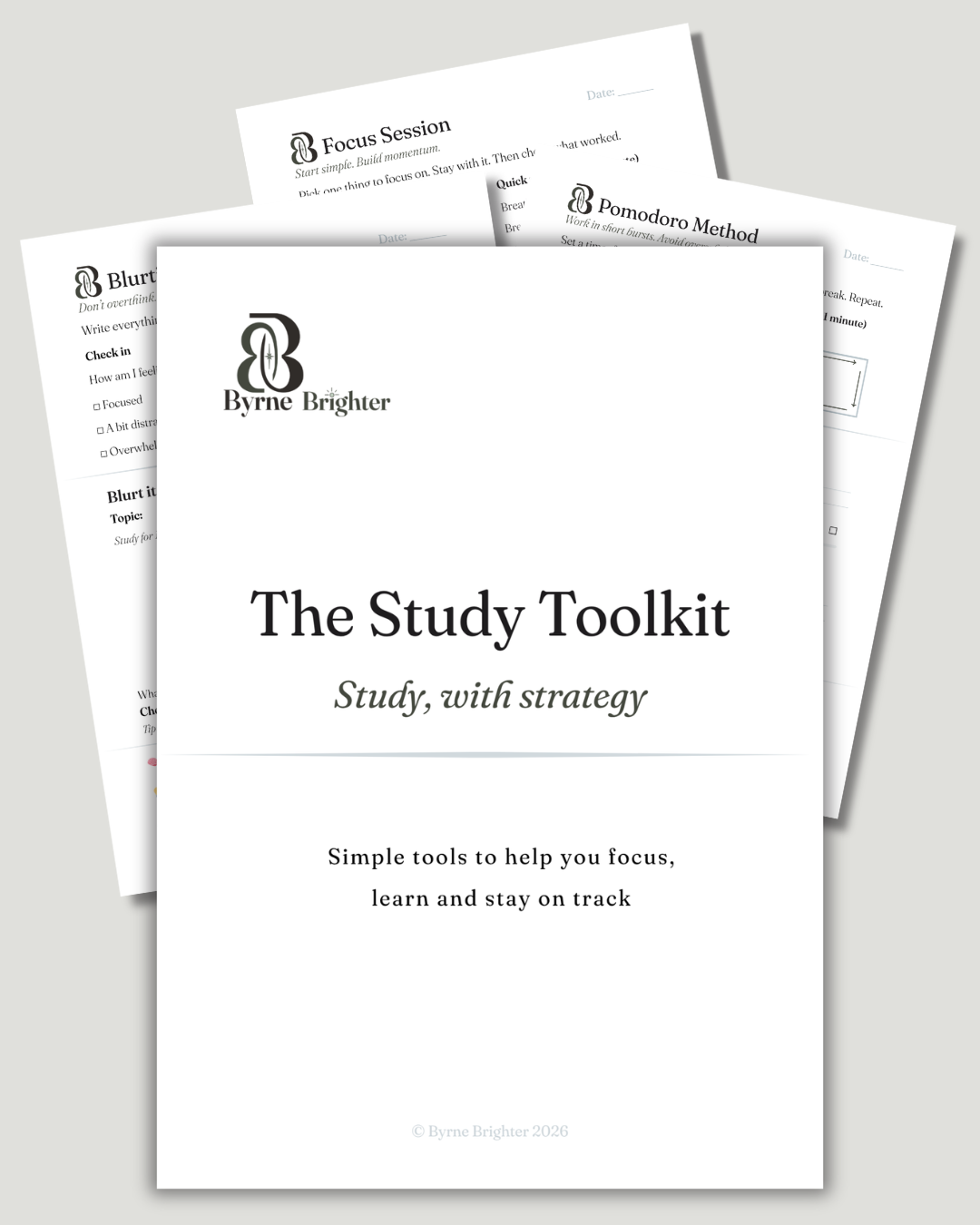
I’ve put together a free Study Toolkit for exam season.
Six practical study methods to explore, plus simple ways to settle before you begin.