
June Reflections: Old Stories, New Perspectives & Updating The File
The book I’ve been living with this month: Think Again
As June draws to a close…
I've found myself thinking about the stories people carry.
Not the big dramatic ones necessarily. More the quiet ones. The family ones. The school ones. The ones that get repeated so often they stop sounding like stories at all and start feeling like fact.
Earlier this month, Sir Keir Starmer announced the UK's new under-16 social media ban, which naturally made me think back to February's blog and Jonathan Haidt's The Anxious Generation. Back then, I was thinking about the environments shaping young people. The phones. The platforms. The invisible pressure of growing up online.
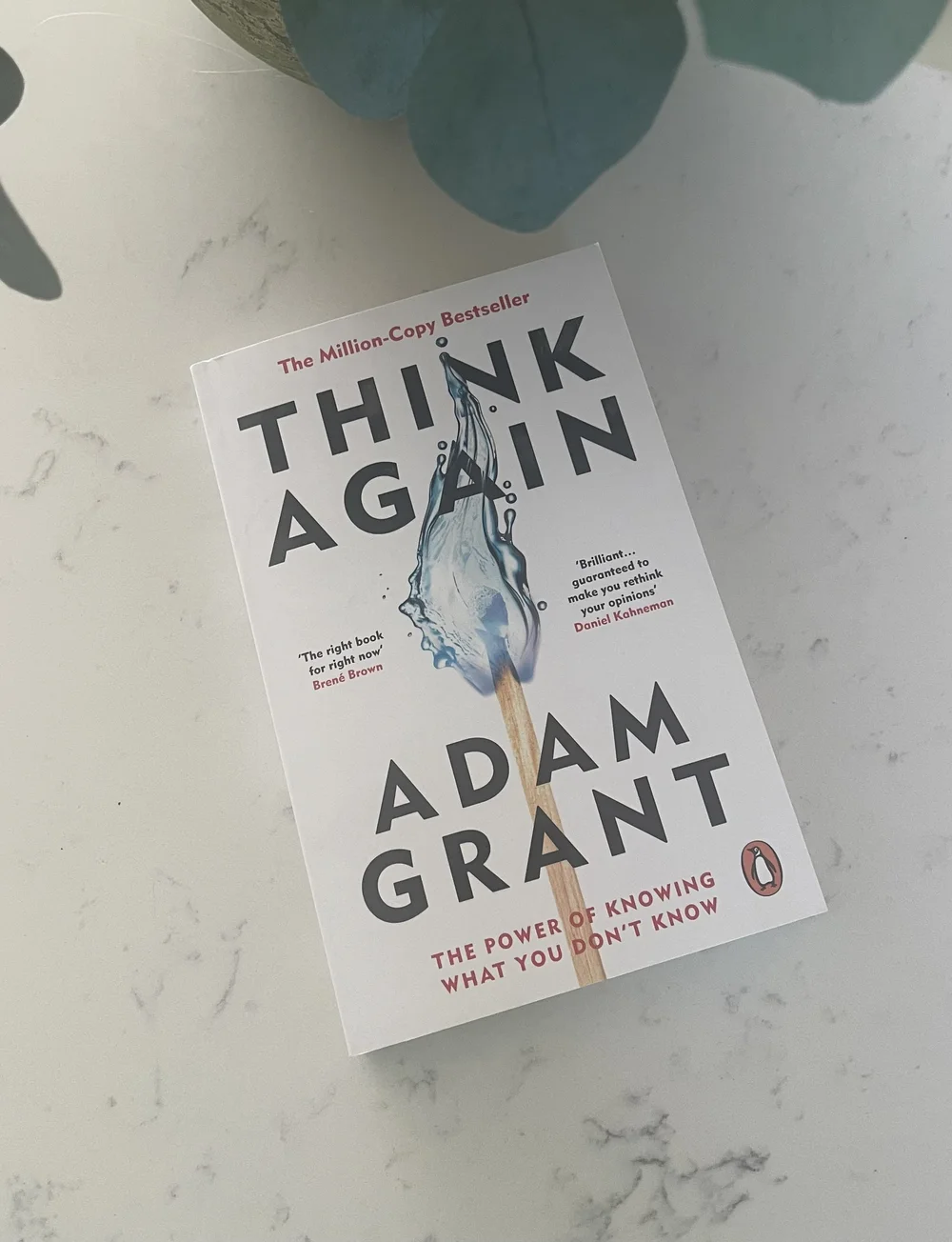
This month’s book was Adam Grant’s Think Again, and it took me somewhere slightly different.
Not just the environments shaping us, but the stories shaping us.
And perhaps more importantly, whether some of those stories need updating.
Families, labels and old stories
Families have funny ways of preserving history.
Not just the milestone moments. Sometimes it’s the embarrassing bit. The nickname you quietly hoped had died. The thing you said when you were fourteen. The wobble. The tantrum. The time you got it wrong. The version of you that everyone else seems to remember with impressive clarity, even though you’ve spent years growing beyond it.
It’s funny how families can remember versions of us we quietly outgrew years ago.
And most of the time, I don’t think it comes from a place of spite. Often it’s fondness. Familiarity. Habit. The warmth of shared history. Families are built partly from stories, after all.
But sometimes those stories can become surprisingly sticky.
Most families have their own cast of characters.
The clever one.
The sporty one.
The dramatic one.
The black sheep.
The family peacekeeper.
The one who always worries.
The one who never quite lives up to their potential.
Sometimes those roles are worn lightly.
Sometimes they become surprisingly difficult to put down.
Particularly when everyone else still expects us to wear them.
You often see it at family gatherings.
The same stories get dusted off and brought back out. The nickname everyone remembers. The embarrassing thing that happened years ago. The joke that still gets a laugh before the punchline has even landed because everyone knows it by heart.
Most of the time it's all lighthearted fun.
Part of the glue that holds families together.
The familiar stories. The sense of belonging that comes from remembering where you've all come from.
Though I sometimes wonder whether the people in those stories would recognise themselves now.
I know I don't in some of mine.
Because while everyone else is laughing about the teenager they remember, the person sitting there may have spent the last twenty years becoming somebody else entirely.
Families aren't the only places stories get written.
Sometimes they begin in classrooms. A passing comment from a teacher.
Sometimes in the playground. A throwaway remark from a friend. The nickname that sticks.
Sometimes on the sports field. Being picked last. Being picked first.
The joke everybody laughed at.
The comparison you never quite forgot.
Childhood has a funny way of handing us stories before we're old enough to question them.
Through comments that were never meant to last as long as they did.
Children often don't get to choose the first stories told about them.
Most of us can still remember at least one of them.
When stories become definitions
At first, these labels often begin as descriptions. A snapshot. A moment. A pattern someone noticed.
But at some point, a description can start behaving like a definition.
And once something starts to feel like a definition, it can quietly shape the way we see ourselves, and the way others see us too.
The thing about definitions is that we rarely think to challenge them.
Because once a label takes hold, we tend to notice the evidence that supports it and overlook the evidence that does not. Psychologists call this confirmation bias.
If we expect a child to be anxious, we may notice every hesitation, every nervous question, every "what if?" moment. The child notices them too.
Meanwhile, the moments that don't fit the story can quietly fade into the background. The time they tried anyway. The time they were scared and still showed up.
It isn't usually intentional.
The brain is constantly looking for patterns, shortcuts and familiar explanations. It likes things to make sense.
And before long, the story can start feeling more permanent than the moment it grew from.
Memory plays a part in this too.
Memory, meaning and certainty
We often talk about memory as if it is a recording, neatly stored somewhere in the brain, waiting to be replayed exactly as it happened.
Yet memory seems far more interested in meaning than precision.
It can shift and soften over time, influenced by emotion, perspective and repeated retelling.
Which perhaps explains why some stories seem to grow stronger with age rather than weaker.
And sometimes what stays with us isn't the event itself.
It's what we came to believe about ourselves because of it.
A failed exam.
A difficult relationship.
A humiliating moment.
A teacher's comment.
The event may have passed years ago.
The conclusion we drew from it can still be sitting quietly in the background.
Not always noticed. Not always questioned.
Just accepted.
Until one day it starts sounding less like a conclusion and more like a fact.
It's just the way I am.
I've always been like this.
For as long as I can remember.
Stories repeated often enough can begin to feel less like stories and more like certainty.
Many of those conclusions were formed years earlier by a much younger version of ourselves.
Updating the belief file
This is where Adam Grant's idea of thinking like a scientist really stayed with me.
In Think Again, he talks about the importance of staying curious, questioning what we think we know and being willing to update what we believe when new information comes along. Not clinging tightly to old opinions simply because they once made sense.
And I kept thinking how useful that idea is when we apply it to ourselves.
Because when was the last time we updated the belief file?
A comment from school.
A relationship that knocked your confidence.
A result that felt like failure.
A version of ourselves formed during a season we were simply trying to survive.
If a scientist would update their conclusion when new information appeared, perhaps we can do the same with some of the stories we carry.
Do you still want the same things?
Do you still believe the same things about yourself?
Are you still trying to meet expectations that belonged to someone else?
I think this matters for young people, especially at this time of year when exams, results and future plans can make everything feel very fixed.
We expect young people to grow and change.
Yet many adults spend years living by assumptions they have never thought to revisit.
One disappointing result can feel enormous when you are standing inside it.
One wobble under pressure can feel like proof.
One hard season can make a young person wonder whether this is simply who they are now.
But one moment is not a whole identity.
One result doesn’t define who you are.
One difficult chapter is not the entire book.
Growth, change and catching up
And the same is true for adults.
Sometimes the challenge isn't changing ourselves.
It's allowing other people time to catch up with the change.
We all carry stories about the people we love. Stories about who they are, what they like, how they behave and what role they play in our lives.
Which may be one reason change can feel surprisingly unsettling, even when it's positive.
Not because the change is wrong.
But because everyone else has to adjust the story they had about us too.
And perhaps that is why growth can sometimes feel a little lonely.
Not because we have lost people.
But because it can take time for the people we love to see who we have become.
There is something hopeful in that.
Because if stories can be shaped by repetition, they can also be softened by new experiences.
This is where neuroplasticity still feels reassuring to me. Not as a magic wand. Not as a promise that everything can be neatly fixed. But as a reminder that the brain is capable of change. We are not as fixed as some of our old stories might suggest.
Why I find IEMT so interesting
This is where Integral Eye Movement Techniques (IEMT) often come to mind for me.
People often assume that working with memories means repeatedly revisiting the past or picking apart every detail of an old story.
In fact, it’s quite the opposite.
What interests me is not so much what happened then, but what is happening now.
How someone responds when they think about that memory.
The feelings that still arrive.
The assumptions that still show up.
The reactions that continue to influence the present long after the event itself has passed.
Sometimes a person is no longer responding as the adult sitting in front of me.
Part of them is still responding from the perspective of the ten-year-old, the fifteen-year-old or the younger adult who first experienced it.
And when that emotional charge begins to soften, people often notice something surprising.
The memory remains.
The facts remain.
But the grip it has on the present can begin to loosen.
That, for me, is where Think Again became more than a book about opinions, arguments or being open-minded.
It became a quieter question.
What else might need updating?
Not because everything we believe about ourselves is wrong.
But because some of it may be out of date.
A conclusion reached years ago.
A role we've carried for so long we've stopped noticing it.
A story that once made sense, but no longer quite fits.
Perhaps the goal is not to erase the past, but to become curious about it.
To notice which stories still serve us.
To question the ones that have become too small.
To leave a little room for growth, revision and possibility.
Because identity is often less fixed than we think.
And maybe the story is not finished yet.
Mentioned in this reflection
The Anxious Generation by Jonathan Haidt
A thought-provoking exploration of how modern childhood has changed, examining the impact of smartphones, social media and growing up online. It sparked many of the ideas behind February's reflections on anxiety, pressure and what young people are navigating today. If you're a parent, it's one of the books I'd most recommend reading.
If you’d like to explore it further, you can- Find the book here →
Thank Again by Adam Grant
A thoughtful exploration of why changing our minds is often a strength rather than a weakness. Adam Grant encourages readers to question assumptions, stay curious and remain open to new perspectives. It was the starting point for many of this month's reflections on labels, identity and the stories we carry about ourselves.
If you’d like to explore it further, you can-Find the book here →
Some links may be affiliate links. As an Amazon Associate I earn from qualifying purchases, at no extra cost to you.
