
The book I’ve been living with this month: A Swim in a Pond in the Rain
As October draws to a close…
I've been thinking about how quickly we make up our minds about things. How a passing comment, an unexpected expression or a message left unanswered can have us piecing together an entire explanation before we've even considered whether we've got all the facts. It's something I notice in everyday life and in my work, but this month it was brought into focus by a rather unexpected book choice: A Swim in a Pond in the Rain by George Saunders.
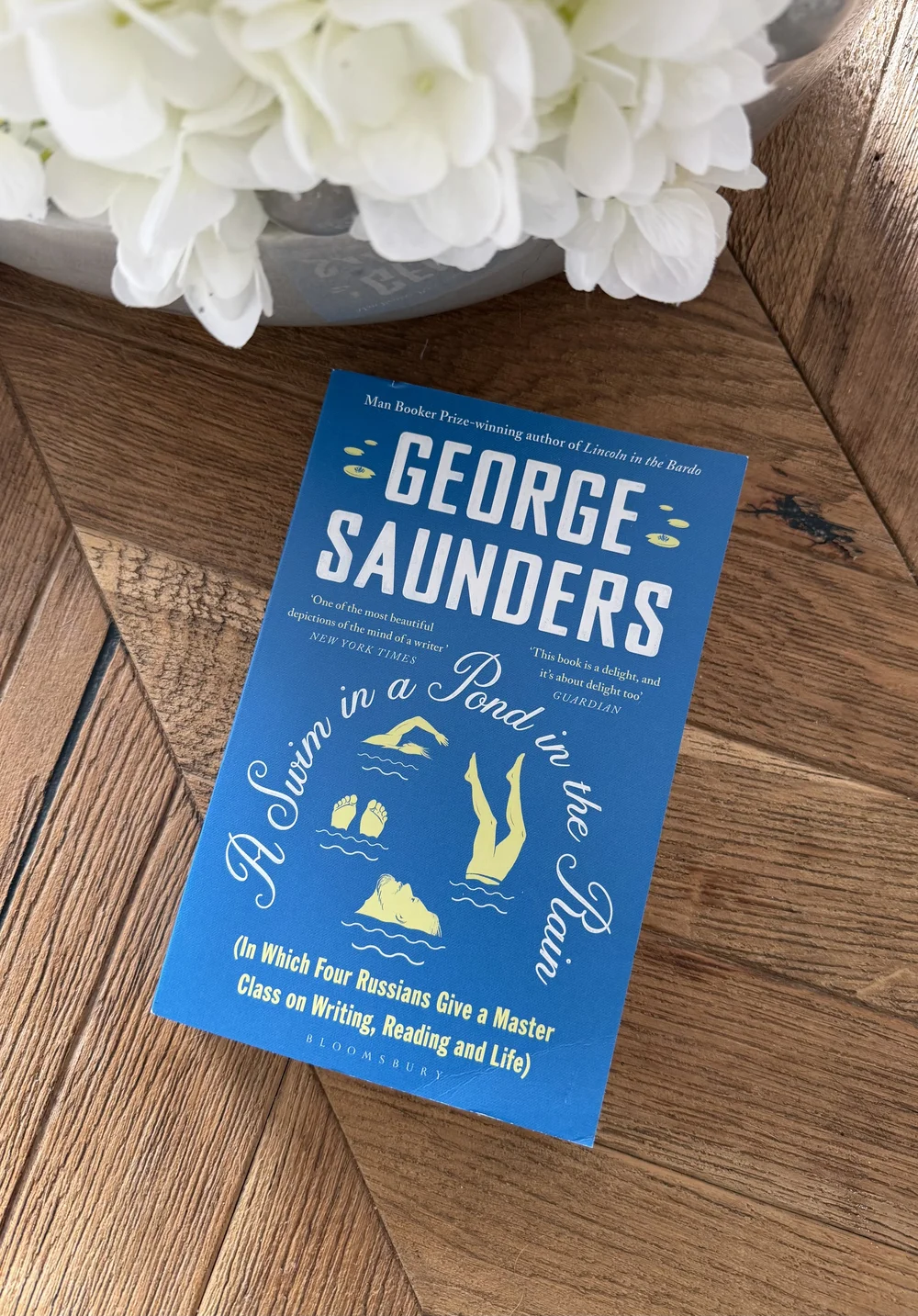
This wasn't actually a book I'd picked out for Byrne Brighter. It had been sitting on my personal reading pile because I've always enjoyed books about writing and the way stories are put together. Saunders takes us through a selection of nineteenth-century Russian short stories, exploring how writers shape our expectations and how we, as readers, make sense of what's unfolding. It was while reading that I started noticing connections to the work I do and, more generally, the way we all interpret the world around us.
Reading a story feels like a fairly passive activity. You're sitting there, turning pages, following the characters. But there's actually quite a lot going on. We're constantly forming impressions, making predictions and drawing on what we already know to work out what might happen next. A character behaves in a certain way and we decide what sort of person they are. A small detail appears and we assume it must be significant. Sometimes we're right, sometimes we're completely wrong, and often we don't even notice how much of the picture we've supplied ourselves.
Saunders has a way of drawing your attention to that process. Rather than simply telling you what a story means, he encourages you to notice how your understanding changes as new information arrives. Something that seemed obvious a few pages earlier can suddenly look quite different.
And I began wondering how often we do exactly the same thing in everyday life.
Making sense of the world
Our birans are rmaekrably good at mkaing snese of tihngs, eevn when the ifnormation isn't qutie rgiht.
How easily did you read that? Did your eyes stumble over the mixed-up letters, or did you barely notice? It's fascinating how our brains can use familiar patterns and context to make sense of something that isn't quite as it should be.
There's an interesting idea in neuroscience called predictive processing, which explores how our brains use previous experiences and expectations alongside incoming information to make sense of what's happening around us. Rather than waiting until we have every detail, we're constantly anticipating what might come next and adjusting our understanding as we go.
We rely on this ability constantly. We can follow a conversation in a noisy café despite missing the odd word, because our brains are remarkably good at using context to fill in the gaps. Most of the time, it's incredibly helpful. But our expectations can also influence how we interpret what's happening, particularly when we don't have the full picture.
And when other people are involved, that's where things can become a little more complicated.
I hear versions of this quite often in sessions. Someone has been left on read. A friend hasn't checked in at their usual time. There's been a cryptic repost on social media, and suddenly the questions begin.
Are they ignoring me? Have I upset them? Is that aimed at me?
Of course, these things can feel enormous when they involve people we care about. And the speed of modern communication doesn't necessarily help. We've become used to being able to contact someone almost instantly, sometimes even knowing whether they're online or have opened our message. It's an extraordinary amount of information about someone's activity, yet remarkably little about what's actually going on in their mind.
And once our brain has offered a plausible explanation, it's surprisingly easy to begin treating it as fact.
It's not just teenagers navigating friendships online, either. I think most of us can recognise ourselves somewhere in this. A colleague who seems a little off, a family member's unexpected comment, someone walking past without acknowledging us. Before long, we've developed a theory about what's going on, and possibly had a whole conversation in our head about it too.
But what interests me is that we don't necessarily stop at coming up with an explanation. If we've decided someone is upset with us, we can start feeling anxious, defensive or rejected before we've even spoken to them. It's almost as though we're bracing for impact, preparing ourselves for something that might never happen.
I wonder how often we put ourselves through all of that, only to discover there was a perfectly ordinary explanation all along.
When did we stop asking?
So why are we sometimes so certain we know what somebody else meant, even when we haven't asked them?
I suppose sometimes it's easier to make an assumption than risk an uncomfortable conversation. We might be afraid of what we'll hear, worried about appearing needy or reluctant to bring something up. And if we've been hurt or rejected before, maybe we're a little quicker to recognise the possibility of it happening again.
Then again, sometimes we're convinced we've got it right. Everything seems to fit, and it doesn't occur to us that there might be another explanation.
Of course, I'm not suggesting we need to question everyone about every unanswered message or passing comment. There will always be things we simply don't know, and perhaps part of the challenge is learning to be comfortable with that.
But isn't it strange how much certainty we can feel about something we're actually quite uncertain of?
Playing detective
Of course, put us in front of a good whodunnit and suddenly we're quite happy to work with incomplete information.
We'll happily accuse half the cast before the next episode. The husband looks suspicious, the neighbour is behaving strangely, and there's something about that helpful friend that doesn't quite add up. By the time the detective gathers everyone in the drawing room, we've probably changed our minds three times.
Getting it wrong doesn't spoil the experience. Quite the opposite. We enjoy discovering what we've missed, how the clues fit together and why our original theory didn't quite hold up.
It seems to me that we're often far more willing to reconsider our assumptions when we're reading or watching a story than when we're caught up in one of our own.
Maybe that's because there's less at stake. Being wrong about the murderer doesn't threaten our relationships, our sense of belonging or how we feel about ourselves. When something matters personally, uncertainty can be much harder to sit with.
But I do like the idea of borrowing a little of that curiosity from the armchair detective. Not necessarily rushing to solve the mystery, but remembering that there may be more than one possible explanation.
Turning the page
And that brings me back to Saunders.
One of the things I've enjoyed about his approach is how he makes you aware of your own participation in a story. You're bringing your experiences and expectations to the page, making sense of what you've been given, and then changing your mind as the story unfolds.
We accept that when we're reading. We don't expect to know everything about a character from the first few pages.
I wonder why we sometimes forget to allow for that possibility with real people.
How often are we convinced we know what someone meant, without ever asking them?
A convincing explanation isn't necessarily a complete one.
The next time our brain offers us an explanation, perhaps it's worth wondering how much of it comes from what we actually know, and how much we've filled in ourselves.
Mentioned in this reflection
A Swim in a Pond in the Rain by George Saunders
If you love literature and are curious about how writers build stories, shape characters and keep us turning the pages, this is a fascinating look at the craft of storytelling.
If you’d like to explore it further, you can- Find the book here →
Some links may be affiliate links. As an Amazon Associate I earn from qualifying purchases, at no extra cost to you.
