
September Reflections: Fresh Starts & What Comes Next
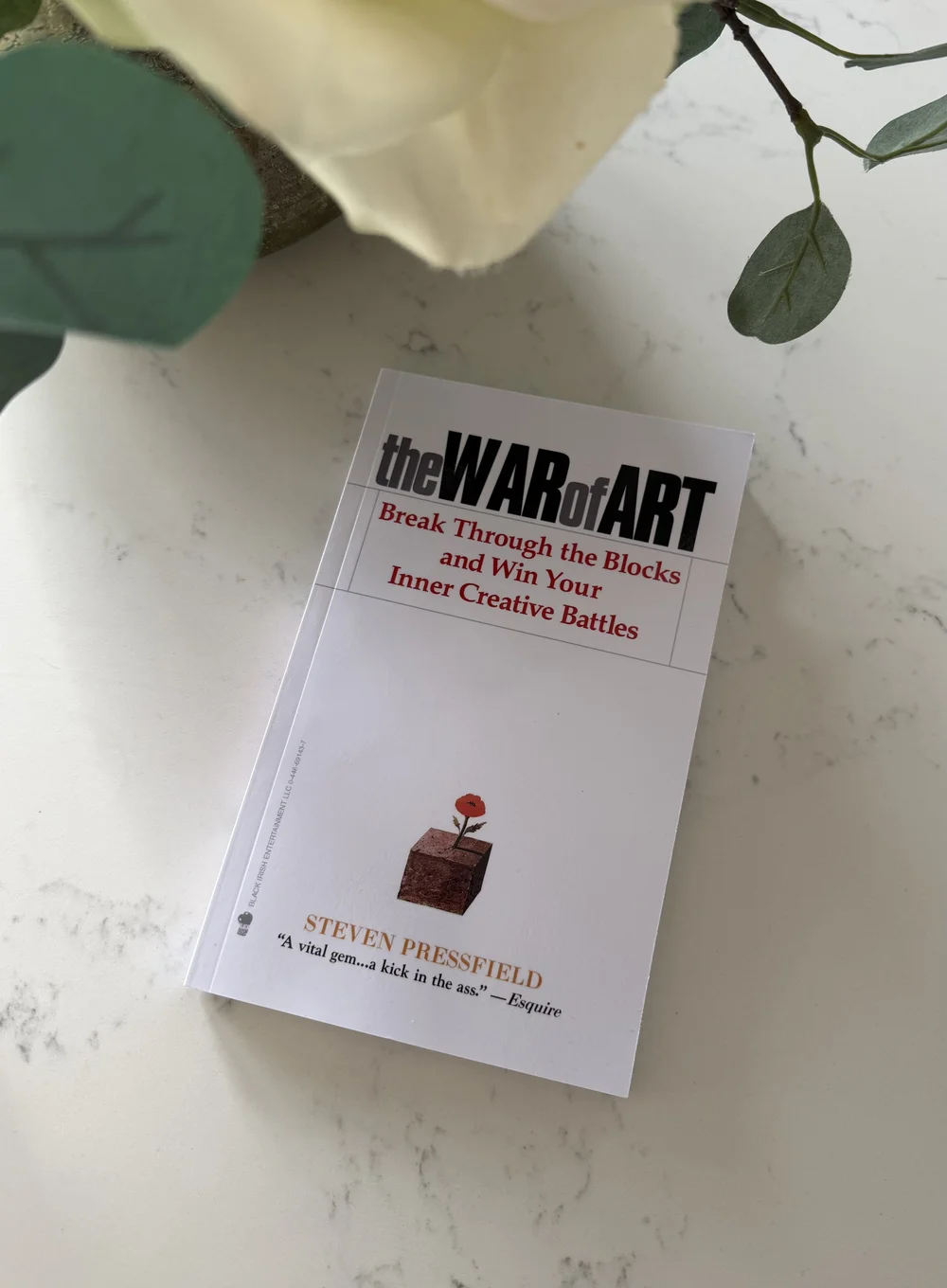
The book I’ve been living with this month: The War of Art
As September draws to a close…
September has always felt a little like the start of a new year to me.
Partly because it's my birthday month, so in one sense it quite literally is. But there's something about September anyway. Schools go back, new terms begin, routines change and after the looseness of summer there seems to be a general feeling of getting back to things.
It's also around now that my thoughts tend to turn towards the year ahead and what I want to achieve.
Not because I'm particularly organised. In fact, quite the opposite.
I'm a creative through and through. I love ideas. I love starting things. I can happily lose hours researching, planning, scribbling in notebooks and disappearing down interesting rabbit holes.
I'm also a self-confessed procrastinator.
Which is probably one of the reasons I was drawn to The War of Art by Steven Pressfield this month.
Recognising Resistance
The book centres around something Pressfield calls Resistance: that strangely persuasive force that seems to appear whenever there's something meaningful we want to do. The voice that says we'll start tomorrow, Monday, when we're less busy, when we know a little more, or in January.
I already knew I procrastinated. What I hadn't really considered was how difficult procrastination can sometimes be to recognise.
Because it doesn't always look like doing nothing.
Sometimes it looks remarkably productive.
Researching. Planning. Preparing. Learning. Tweaking. All things that can genuinely help us move towards something, but all things that can also keep us safely circling it.
I love researching. One question leads to another, which leads to something I hadn't considered, which sends me somewhere completely unexpected. Some of my best ideas have arrived because I've wandered off piste, so I certainly don't want to stop doing that.
But there comes a point when I have to ask myself whether I actually need to know more, or whether I'm delaying the bit where I have to do something with what I already know.
Is what I'm doing moving me towards the thing I said I wanted, or quietly moving me away from it?
The appeal of a fresh start
I've always liked making my New Year's resolutions in September rather than waiting for January. If there's something I want to change or achieve, it gives me a few months to actually start moving towards it.
January can feel like an enormous starting line. We reach the end of December after weeks of disrupted routines, late nights, celebrations and overindulgence, then expect ourselves to wake up on the first of January ready to overhaul everything.
September gives me a bit more breathing room.
If feeling fitter and healthier is something you want for the year ahead, for example, why wait until January to begin? Starting now gives you time to work out what you actually enjoy, what fits realistically into your life and, by the time Christmas arrives, you might already be feeling a little stronger and healthier.
It doesn't have to be fitness, of course. Whatever the thing is, there's time between now and January to begin it rather than simply plan to begin it.
There is, of course, an uncomfortable irony in all of this.
A date can give us a useful starting point, but it can also give us permission to wait for it.
Monday.
Next month.
After Christmas.
January.
My birthday.
When things calm down.
When I know what I'm doing.
There's always another starting line available.
It turns out there may be something in our fondness for a starting line. Researchers Hengchen Dai, Katherine Milkman and Jason Riis call it the “fresh start effect.” They found that our motivation to pursue goals can increase around what they describe as temporal landmarks, the start of a new week, month or year, a birthday or even a holiday.
The researchers suggest these moments can create a kind of psychological dividing line between what came before and what comes next.
Which might explain why September has always had that feeling for me. A birthday, a new school year, routines beginning again, I'm practically surrounded by starting lines.
But while a fresh start might help us begin, it can't do the continuing for us.
What happens after the beginning?
Pressfield makes a distinction in the book between approaching our work as an amateur and approaching it as a professional.
The word professional can sound as though it belongs to somebody who's already accomplished at something, but that isn't really what interested me about the idea. It's more about the way we approach the work.
A professional turns up.
Not only when inspiration strikes or enthusiasm is high. Not only when the conditions are perfect or everything else is out of the way. They make room for the thing they say matters to them.
And I think that's the part I've been chewing on.
We put so much emphasis on the beginning. The resolution. The first day. The fresh start.
But most of what we want to achieve happens afterwards.
There's a familiar rush that comes with a beginning. Buying the kit for a new hobby. Signing up for something. Making the plan. Deciding this is it. Even telling somebody we're going to do it can feel satisfying.
And sometimes this is it carries something else too: this has to work. Starting again, changing direction, building something new or reinventing some part of our lives can make a beginning feel daunting before we've even got going.
Either way, beginnings get a lot of our attention.
But what happens when the beginning is over?
Eventually the newness wears off. The hobby we couldn't stop thinking about becomes something we have to remember to make time for. The plan that felt so exciting when we made it meets real life. Progress might be slower than we'd imagined. We miss a day, a week. Something else catches our attention.
And I wonder how many resolutions fail not because we're incapable of doing the thing, but because we expect the feeling we had when we decided to do it to last.
That doesn't necessarily mean we chose the wrong thing. Sometimes we do, of course. We're allowed to discover that something isn't for us and change our minds.
But there's a difference between deciding something no longer matters to us and simply reaching the part where it isn't exciting anymore.
And this is where Pressfield's idea of the professional becomes useful.
They come back.
Not perfectly. Not necessarily every day. But often enough for the thing to survive beyond the excitement of having started it.
Maybe consistency isn't quite the unbroken line we sometimes imagine it to be. Real life has a habit of interrupting even our best-laid plans. We get ill. Work gets busy. Christmas happens. Sometimes we simply get out of the habit.
The difference might be what happens next.
Do we decide we've blown it and wait for another starting line? Or do we return to the thing?
What survives the fresh start?
I've always thought starting my resolutions in September gave me a head start on January. What I'm really giving them is time to get past the excitement of beginning.
By January, whatever I started has had a chance to meet my actual life.
I've had time to find out whether I really want it, whether it fits, what needs adjusting and whether I can pick it back up after I've dropped it.
And maybe that's a much more useful test than how enthusiastic I felt on the day I began.
Only yesterday, someone mentioned something they were going to concentrate on in January. There was nothing unusual about it — we all do it — but after spending this month thinking about exactly that, my ears pricked up.
What could already be underway by then?
Not finished or perfected. Just underway.
By January, as I'm wrestling the Christmas decorations back into their boxes, I'm less interested in what I'm excited to start and more interested in what has survived.
What mattered enough that I kept coming back?
There's something reassuring in that. It takes some of the pressure away from getting everything right at the beginning. I don't need the perfect plan before I start, or to interpret every wobble as proof that I've failed.
I just need to notice whether I'm still moving towards the thing I said I wanted.
I'm fairly certain reading The War of Art hasn't cured me of procrastination. There will be more rabbit holes. There will almost certainly be more research than strictly necessary. And I'm sure I'll continue to have ideas at a considerably faster rate than I can actually do anything with them.
Nor would I particularly want any of that to change. But maybe I'll get a little better at recognising when an interesting rabbit hole is genuinely taking me somewhere, and when I'm simply hiding in it.
And a little better at finding my way back out when I need to.
I still like September as my New Year. I like the sense of possibility that comes with it and I don't think there's anything wrong with looking ahead, making plans or getting excited about what might come next.
The danger isn't dreaming about tomorrow. It's continually giving tomorrow the job that belongs to today.
So this year, I'm less interested in arriving at January having somehow transformed myself in four months.
I'd rather arrive with something worth doing already in motion. Something that has survived the exciting beginning, met a few ordinary days, been interrupted, adjusted and returned to.
Something I haven't left waiting for January.
And when January does arrive?
I can just carry on.
Mentioned in this reflection
The War of Art by Steven Pressfield
A short, thought-provoking read exploring what Pressfield calls Resistance, the procrastination, distraction and hesitation that can get in the way of doing work that matters to us.
If you’d like to explore it further, you can- Find the book here →
Research ref: The Fresh Start Effect - Management science
Some links may be affiliate links. As an Amazon Associate I earn from qualifying purchases, at no extra cost to you.
