
August Reflections: Rest, Space & What Happens When We Stop
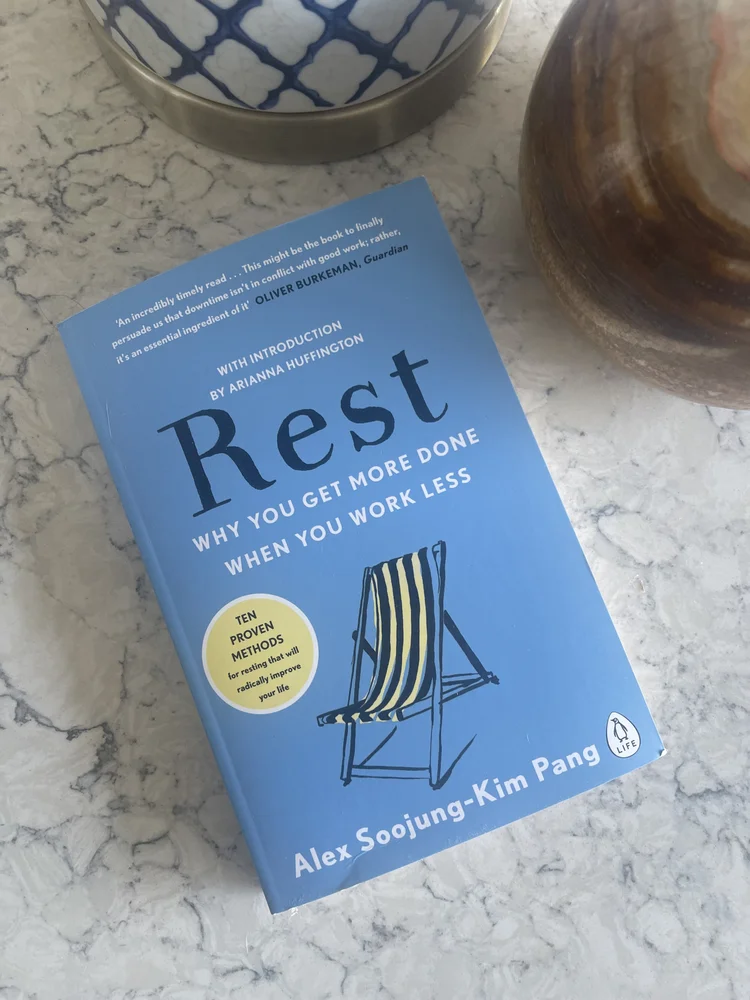
The book I’ve been living with this month: Rest
As August draws to a close…
Summer holidays.
After months of looking forward to them, suddenly they're here. There’s something about the words themselves that suggests we're supposed to be resting.
For much of the school year, summer sits somewhere on the horizon as the point when everything will finally slow down. Get the exams out of the way. Get to the end of term. We'll have more time in the summer. We'll see them in the summer. We'll do that in the summer.
Then summer arrives and, particularly if you have children, I'm not entirely sure anybody told summer about the resting part.
Maybe that's why Rest by Alex Soojung-Kim Pang felt like a well-timed choice from my reading pile this month. I can't say everything in it was new to me, but it did make me question something I'd probably never really thought about before: what do we actually mean by rest?
Because having time away from work or school isn't necessarily the same thing.
When time off isn't quite rest
I heard someone on a podcast recently talking about the idea of approaching a family holiday as a trip instead of a holiday. It stuck with me, because perhaps the word holiday comes with more expectations than we realise. We don't just expect to go somewhere; we expect to have a break, to rest, recharge and come home feeling somehow rejuvenated.
A family trip doesn't make quite the same promise. It can still be brilliant, exciting and full of memories, but rest and relaxation aren't necessarily prerequisites. If they happen too, then that's great. But perhaps we haven't failed at having a holiday if we come home needing one.
Maybe the same is true of the six-week summer holiday.
For some parents, it's trying to stretch limited annual leave across a much longer school break. Those precious days together can bring their own pressure to make the most of them, possibly with a little guilt about not being there for the rest. Then begins the childcare Tetris of grandparents being drafted in, holiday clubs and favours from friends.
Working from home might appear to offer more flexibility, but being at home isn't quite the same thing as being available, which is something that's understandably difficult to explain to a child who can clearly see you just sitting there. Sometimes what looks like flexibility from the outside can feel more like fragmentation from the inside. The juggle struggle is real.
And for families with fewer plans, six weeks can feel like an incredibly long time in a completely different way. Are the children bored? Should we be doing more? Are we making enough memories?
It probably doesn't help that we can now see everybody else's summer too. Someone's abroad. Someone's at a theme park. Somebody's children appear to have spent Tuesday paddleboarding while another family is painting pottery in a group you weren't invited to.
It's so easy to compare an ordinary Tuesday with the ten seconds somebody else chose to share from theirs.
Whichever version of summer we're living, it's natural to glance across at somebody else's and imagine they've got the bit we're missing.
Sometimes we place an awful lot of expectation on these breaks too. We count down to holidays and special occasions, imagining how they'll look and how we'll feel when we finally get there. They can be every bit as lovely as we'd hoped. Other times, the weather changes, someone gets tired or ill, plans go wrong or reality simply struggles to compete with the months of anticipation.
So maybe the problem isn't always how much time we have, but what we expect ourselves to do with it.
And perhaps we've confused not being at work or school with actually resting.
When busy becomes the default
That thought stayed with me as I read Rest, because Pang explores our relationship with work as much as he does rest. We live in a culture where being busy can almost become a badge of honour. Working all hours, being permanently reachable and not having stopped all week can sound like evidence that we're committed and productive.
Even when we're technically on holiday, how many of us still check the work email?
Where exactly is the line between being switched on and switched off anymore?
Maybe that's part of the problem. Have some of us become so accustomed to being busy that switching off is something we have to relearn?
Give us an unexpected quiet afternoon and some of us don't quite know what to do with it. Leave a tiny gap in the day and the phone comes out almost like a nervous twitch. Queue? Phone. Ad break? Phone. Waiting for somebody? Phone.
But it's not just our phones. We fill the gaps with work, plans, background noise, entertainment and other people. There are plenty of ways to make sure there's rarely much empty space left.
How comfortable are we when nothing and nobody is demanding our attention?
Then there's the question of what actually restores us, because that won't necessarily look the same for everybody. A long walk might clear one person's head and bore somebody else senseless. An afternoon surrounded by friends might leave one person energised and another desperate for a quiet room.
What looks like rest from the outside tells us surprisingly little about whether we're actually resting.
Maybe that's the better question: not does this look like rest? but does it actually restore us?
Sometimes stopping is part of the work
One of the ideas Pang returns to in Rest is that productive work and deliberate rest aren't necessarily opposites. A lot of the people he writes about weren't working every available hour. They worked hard, but they also walked, slept, exercised or did something completely different.
Ever found yourself desperately trying to remember the name of someone you knew twenty years ago? Or searching for exactly the right words to explain what you mean? Perhaps it's a problem you've been wrestling with for hours and the harder you think about it, the further away the answer seems to be.
Eventually you give up and do something else.
Then, half an hour later, there it is.
There is research suggesting that even something as simple as going for a walk can support creative thinking. And sleep too is far from the inactive state it might appear to be. While we sleep, the brain continues processing and consolidating information and memories.
Perhaps sleep on it deserves a little more credit than we give it.
An argument that feels enormous at 11.30 at night can look different over breakfast. A problem we couldn't solve yesterday sometimes seems clearer in the morning. The circumstances haven't necessarily changed, but we've stopped consciously pushing at them for a while.
It's something that also makes me think about hypnotic trance. There's a common misconception that hypnosis means being asleep or somehow switched off. It doesn't. Someone may look deeply relaxed during trance, but hypnosis is better understood as a state of focused attention and absorption. Within Solution Focused Hypnotherapy, we sometimes draw comparisons with REM sleep when talking about how the brain processes experiences. It's a useful way of explaining the idea, although trance itself isn't REM sleep.
The bit I find interesting is simpler than that: stillness isn't necessarily inactivity.
Sometimes stopping is part of the work.
One thing at a time
And maybe rest doesn't always require us to stop everything either. Sometimes we could just ask our attention to do a little less.
What we casually call multitasking is often our attention switching backwards and forwards between different demands. We can become so used to it that concentrating on just one thing can feel almost unusual.
There's a wonderfully unexciting name for deliberately doing that:
Single-tasking.
Watch the film without scrolling.
Eat lunch without answering emails.
Drink the coffee while it's still hot.
Listen without thinking about what you'll say next.
None of those things requires a holiday, a free afternoon or even very much time.
Maybe doing one thing at a time isn't about doing less.
Maybe it's about being there for more of it.
Which brings me back to these six weeks.
As the summer holidays come to an end, it's tempting to measure them by what we did. Where we went. How much we fitted in. Whether they looked anything like the summer we'd imagined at the beginning.
Maybe some of it was brilliant. Maybe some of it was disappointing. Maybe there are things we'd do differently next time.
But perhaps making the most of our time doesn't necessarily mean filling the most of our time.
Maybe some of those spaces matter too: the ordinary afternoons, the conversations, the walks, the film we actually watched, the cup of coffee we drank before it went cold.
And that's what Rest has left me wondering. Not whether we're resting enough, or whether we're doing it properly, but something I'm not sure I could have answered when I first picked up the book:
What actually restores us?
Mentioned in this reflection
Rest by Alex Soojung-Kim Pang
A thoughtful exploration of the relationship between work and rest, and why stepping away isn't necessarily wasted time. It's the book that sparked this month's reflections on busy lives, empty spaces, attention and what actually restores us.
If you’d like to explore it further, you can- Find the book here →
Some links may be affiliate links. As an Amazon Associate I earn from qualifying purchases, at no extra cost to you.
