
July Reflections: Direction, Attention & The People We Meet
The book I’ve been living with this month: Into The Magic Shop
As July draws to a close…
School's out.
And I've found myself wondering where the time went.
My youngest has just finished primary school.
It doesn't seem five minutes since she was learning to write her name and I was waving through every classroom window I could find, hoping for one last glimpse before carrying on with my day.
Now she's walking towards a whole new chapter with far less need to look over her shoulder.
There's something particularly bittersweet about it being the last time.
No more primary-school playgrounds. No more familiar walk to school. No more catching a teacher at the door, chatting with other parents while we wave. No more little glimpses into a world that, for years, we've been lucky enough to share up close.
I'm incredibly grateful we got to.
That's one of the strange things about parenting. For years, their world feels relatively small and familiar. We know their teachers, their friends and often their friends' parents too. Then, gradually, we have to trust them to step into a much bigger one.
New friends. New teachers. New influences. Conversations we won't necessarily hear. Opinions we haven't given them. Kindness we won't witness and, inevitably, moments we'd probably rather protect them from.
And somewhere amongst all of that, there will be people who leave a mark.
People who may play only a tiny part in their lives.
And some they might remember forever.
Which has had me thinking about a question that seemed to have followed me around this month:
What quietly shapes the direction we take?
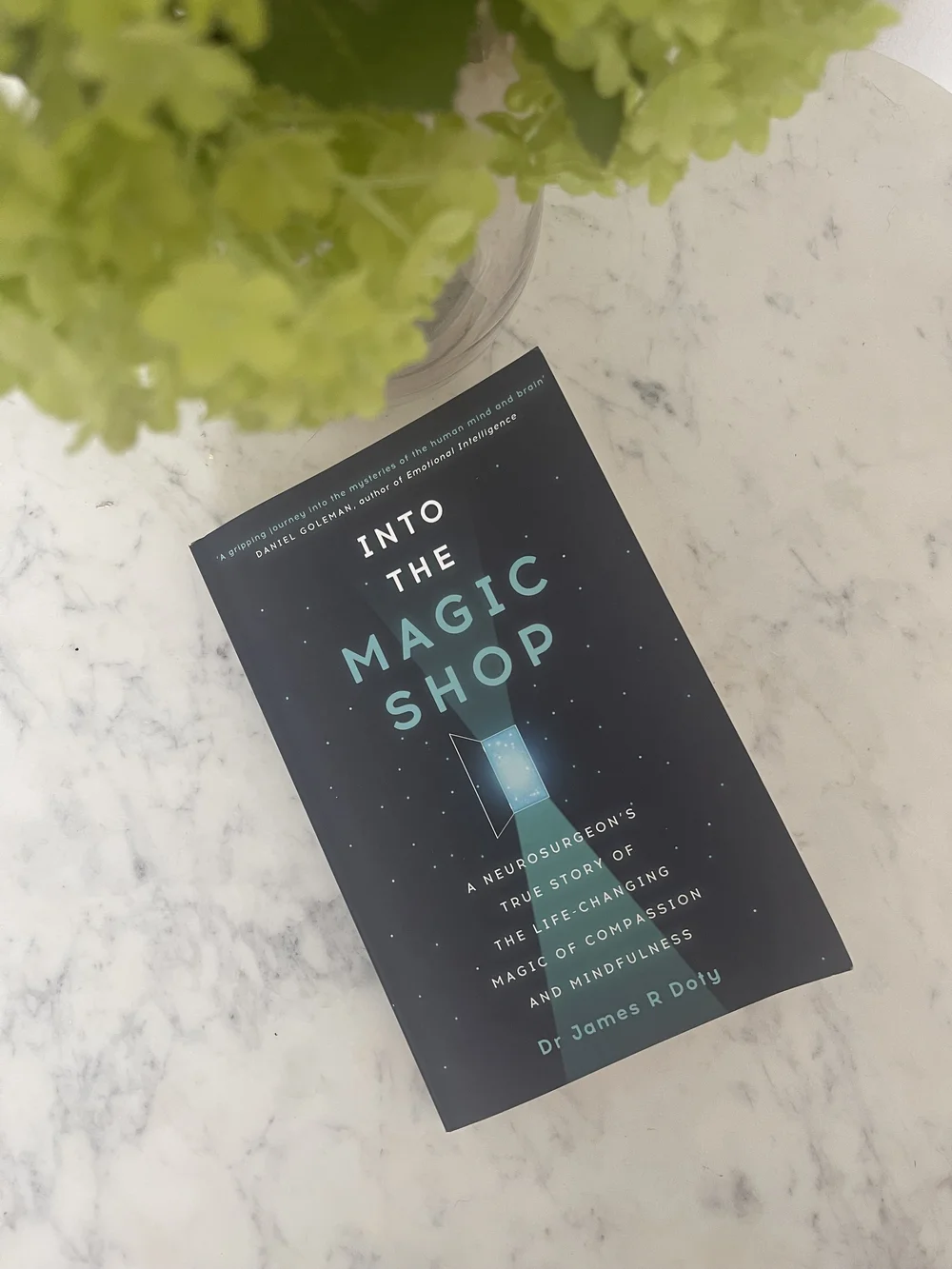
Into the Magic Shop
This month's book was Into the Magic Shop by Dr James Doty.
I wasn't quite sure what to expect from it. From the outside, it could easily be described as a book about manifestation, visualisation or extraordinary success.
And there is some of that in there.
That wasn't what really stayed with me.
Doty grew up in difficult circumstances and, as a boy, wandered into a magic shop looking for his brother. There he met Ruth, the mother of the shop's owner, who offered to teach him a different kind of magic.
She taught him how to calm his body, quieten some of the noise in his mind, focus his attention and imagine possibilities beyond the circumstances immediately in front of him.
But what struck me most wasn't what Ruth taught him.
It was that she took the time to teach him at all.
Here was a child she barely knew, and an adult who chose to notice him.
To listen.
To take him seriously.
To give him her time.
She couldn't possibly have known where that time would lead.
Years later, that boy would become a neurosurgeon and professor. Ruth never got to see the person he became or know just how far her influence travelled. He never saw her again.
I found that unexpectedly moving.
It reminded me of a quote about teachers that I've read from the American historian Henry Adams:
“A teacher affects eternity; he can never tell where his influence stops.”
As we close our own primary-school chapter, that feels particularly poignant.
Teachers rarely get to see the finished story.
They meet children somewhere near the beginning.
They might never know which encouraging word was remembered, which moment of patience mattered, or whether something they said changed the way a young person saw themselves.
Most of those moments probably don't look important while they're happening.
Maybe that’s the point.
We rarely know how far kindness, encouragement or somebody else's belief in us will travel.
Then Morrie wandered in
While I'd been sitting with all of this, and, if I'm honest, dragging my feet slightly over writing it, I picked up another book from my ever-growing reading list.
Tuesdays with Morrie by Mitch Albom.
It was relatively short. I had a gap between books. I thought I'd read a few pages.
I finished it that day.
Different book.
Different relationship.
Yet I found myself thinking exactly the same thing.
Mitch Albom had adored and respected his university professor, Morrie Schwartz. Then graduation happened. Careers happened. Life happened.
They lost touch.
Years later, Mitch saw his old professor on television and discovered that Morrie was dying. He sought him out, and their relationship resumed through a series of Tuesday visits during the final months of Morrie's life.
Again, what stayed with me wasn't simply the wisdom Morrie shared.
It was the relationship.
The influence one person had left on another, even during the years when they weren't in each other's lives.
There was something especially touching about Morrie getting to see that.
Ruth never knew where her influence stopped.
Morrie did.
Mitch came back.
I think that's why the two books unexpectedly found themselves sitting beside each other in my mind.
We talk a lot about the people who achieve extraordinary things.
We talk a little less about the people who helped them believe they could.
Learning to navigate a bigger world
Of course, we can't vet every person who enters our children's lives forever.
Nor should we.
So our role begins to shift. It’s less about being closely involved in the world around them and more about giving them space to navigate it for themselves.
To notice how people make them feel.
To question something that doesn't sit right.
To ask for help.
To know that getting something wrong isn't the same as being wrong.
And to recognise the people who make their world a little bigger in the best possible way.
Because somewhere along the way, they'll find their own Ruths and Morries.
Hopefully more than one.
Making the unfamiliar a little more familiar
Of course, knowing that change is a normal part of growing up doesn't mean it always feels comfortable.
Our brains are rather fond of knowing what's coming next.
I'm certainly no exception.
If I know I have to go somewhere I've never been before, there's a very good chance my poor husband will be recruited to reccy the route with me beforehand.
I like knowing where I'm going.
Where I'll park.
Which entrance I'm looking for.
Yes, I realise that satnavs and Google Maps exist.
Apparently this is not enough.
But there is something useful underneath my need to physically inspect the destination.
Familiarity can take some of the uncertainty out of something new.
And that's useful when children are preparing for a new school too.
Walking the route together. Finding the bus stop. Looking at the school map. Talking through what the first morning might look like or what might be on offer for lunch.
Not endlessly rehearsing everything that could go wrong.
Quite the opposite.
Helping the brain rehearse.
I know where I'm going.
I know what I can do if I'm unsure.
I know who I can ask.
I've handled new things before.
Mental rehearsal is something we use across many different settings, from sport to performance to therapy. Imagining an experience doesn't guarantee an outcome, of course, but rehearsing how we might respond can make the real situation feel less unfamiliar when it arrives.
And maybe that's a little of the "magic" Ruth was teaching.
Not wishing for a different future.
Practising how you might meet it.
It's something we use in Solution Focused work too. We often spend time exploring a preferred future.
What would be different?
What might you be doing?
What small thing would show you something had begun to shift?
Not because describing a future magically creates it, but because having some sense of where we'd like to be gives us something to move towards.
Intention isn't the same as wishing.
Sometimes it's simply getting a little clearer about the direction we'd like to go.
What are we paying attention to?
And then there's attention. This is where some of Doty's ideas really interested me.
There's far too much going on around us for our brains to pay attention to everything at once. Our attention is selective, bringing some things into focus while plenty of others pass us by.
The Reticular Activating System, or RAS, plays a part in this. It's involved in keeping us alert and responsive to what's happening around us, although, like most things involving the brain, attention is far more complicated than one system working alone.
You can see selective attention at work in everyday life.
When your daughter announces that she absolutely needs a White Fox hoodie, for example, you suddenly realise half the pre-teens you pass seem to be wearing one.
They haven't all rushed out and bought one overnight.
You just weren't noticing them before.
What we look for, what we're doing and what matters to us all influence what catches our attention.
And I think that's worth remembering when we're helping children through change.
If every conversation is:
Are you nervous?
What if you get lost?
What if you don't know anyone?
We may unintentionally keep directing their attention towards everything that could go wrong.
That doesn't mean ignoring genuine worries or plastering positivity over them. If they're worried, of course we need to listen.
But we can make room for other questions too.
What are you looking forward to?
What are you curious about?
What already feels a little easier than it did?
If you weren't sure where to go, what could you do?
We're not promising everything will go perfectly.
We're simply making room for something other than the worry.
And sometimes, a wider view helps us notice possibilities alongside the problems.
The people along the way
When I look back, I can see those people in my own life.
I suspect most of us can.
The person who made us laugh when we needed it.
The person who took us seriously.
The person who saw something in us we hadn't quite learnt to see for ourselves.
Some stay for decades.
Others appear for a chapter.
Some may never know they mattered at all.
That's why Ruth stayed with me.
And why Morrie unexpectedly joined the conversation.
Neither could decide the direction another person's life would take. But both, through attention, kindness and connection, helped illuminate a little more of the road.
Primary school is done.
Those years went far too quickly.
I loved having a front-row seat. I still want one. But I know her world needs to become bigger than my view of it.
So as she steps into whatever comes next, I can only hope we've given her enough confidence and curiosity to find her own direction, and the good fortune to meet a few Ruths and Morries along the way.
And perhaps, without ever knowing it, to be one for somebody else too.
Mentioned in this reflection
Into the Magic Shop by Dr James Doty
A moving memoir exploring attention, visualisation, compassion and the unexpected influence one person can have on another. It's the book that sparked this month's reflections on direction, parenting and the people who quietly shape our lives.
If you’d like to explore it further, you can-Find the book here →
Tuesdays with Morrie by Mitch Albom
A beautifully written memoir about a former student reconnecting with his dying university professor. Full of wisdom about relationships, perspective and what really matters, it unexpectedly became part of this month's conversation too.
If you’d like to explore it further, you can-Find the book here →
Quote Source
The source of the quotation, "A teacher affects eternity; he can never tell where his influence stops."
The Education of Henry Adams by Henry Adams
An American autobiographical classic exploring education, history and personal growth.
If you’d like to explore it further, you can-Find the book here →
Some links may be affiliate links. As an Amazon Associate I earn from qualifying purchases, at no extra cost to you.
