
February Reflections: Anxiety, Teenagers and the Modern World
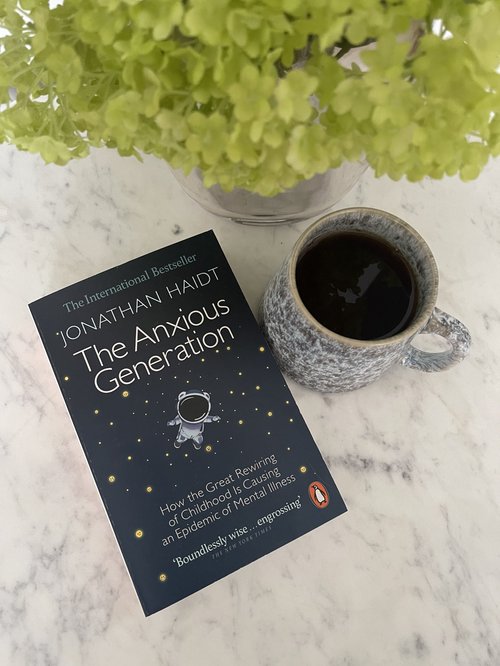
The book I’ve been living with this month: The Anxious Generation
As February draws to a close…
I’ve found myself thinking a lot about the world our young people are navigating, and how different it feels from the one many of us remember.
The Winter Olympics have been on in our house, and it has been genuinely fun watching my kids suddenly learn the athletes’ names, become seriously invested in curling strategy, and discover sports they didn’t know existed a week ago.
I have always loved watching it. I find it inspiring, and the scenery alone is worth tuning in for.
I heard freestyle skier Eileen Gu speaking in an interview about dedication and the mental side of training. At one point she mentioned neuroplasticity, the brain’s ability to change and adapt through repeated practice. My ears pricked up immediately. My clients know I do tend to bang on about neuroplasticity in sessions.
It was refreshing to hear a young athlete talk not only about physical training but about shaping the mental side of it too. Repetition strengthens pathways. What we practise is what gets wired in. That’s true on the slopes, and it’s true in everyday life.
That said, I have found myself wielding my dishmatic like a seasoned curling pro while doing the washing up. I clearly need to get out more.
But humour aside, there is something quietly powerful about watching that level of focus and commitment. It has made me think about practice, about showing up repeatedly, and about the kind of environments that help young brains to thrive.
And that brings me to the book I’ve been living with this month.
Jonathan Haidt’s The Anxious Generation has been nudging at similar questions.
The world they’re growing up in
One of the ideas that stayed with me is his distinction between what he calls a play-based childhood and a phone-based childhood.
Many of us grew up with a version of freedom that now feels almost radical. We were out on bikes. We knocked for friends. We disappeared for hours. We were physically together. We read social cues the messy way. We argued and made up in real time.
At the same time, we were steeped in “stranger danger”. I grew up with the tragedy of Jamie Bulger in the background. Films like The Lovely Bones and Taken reinforced the sense that danger lived outside. So when we became parents, we did what loving parents do. We became more careful. We locked the doors. We kept children closer to home.
And while we were protecting them physically, something else was expanding quietly in another room.
Haidt writes that we overprotected children in the real world and underprotected them online.
That line lingered with me.
He paints this image of a mother in the kitchen assembling a kaleidoscope of nutrient-dense food, feeling she is doing everything right, while her child upstairs is navigating an entirely different digital world she cannot see.
I have absolutely been a rainbow veg mum. I genuinely felt like I was winning at something.
It is uncomfortable to recognise that while we were carefully monitoring sugar intake, platforms were being refined to capture attention, shape identity and influence mood.
This is not simply about “screens.” It is not the same as sitting down to watch a film. A film ends. Short-form content does not. Infinite scroll has no natural stopping cue.
The next video might be brilliant. Or shocking. Or dull. Your brain does not know.
And that unpredictability matters.
Our brains are wired to notice potential rewards. A little burst of dopamine, the chemical that helps drive motivation, encourages us to keep scrolling, just in case the next swipe delivers something better.
That is not weakness. It is wiring.
That does not mean all technology is harmful. Video calls connect families across continents. FaceTime kept grandparents and grandchildren close during lockdown. Screens can bridge distance in beautiful ways.
Seeing someone’s face, reading expression in real time, still matters. Connection is not the problem. Design is.
And that is partly the point Haidt makes. He is not blaming parents or teenagers. He argues that these platforms were deliberately designed to tap into vulnerabilities in the developing brain. Expecting willpower alone to compete with products created by very clever people, backed by enormous resources, was probably asking quite a lot.
We were up against something powerful.
There is a part in the book where his daughter, who was six, asked him to take her iPad away because she could not stop looking at it. That moment made me sit up in recognition. I have done that too. I have opened TikTok “for five minutes” and resurfaced hours later feeling a little frazzled and wondering what had just happened.
We are not immune. Our children certainly are not.
And for young people, it is not just the pull of the scroll. It is what the scroll contains.
The public stage
We all remember the feeling of wanting to fit in, of wanting to be liked. That never really leaves us.
But unlike our childhoods, our children are growing up on a stage where likes and looks are visible, counted and compared.
That changes things.
For girls in particular, that constant comparison seems to be hitting earlier and harder in their teens. The rise in anxiety, low mood and self-harm among teenage girls in recent years is difficult to ignore. Boys are affected too, though often later and in different ways.
Adolescence has always been a sensitive season. Add a visible audience to that, and it can feel heavier.
Not panic. Understanding.
This is not about panic. And it is not about blaming devices alone. It is about recognising that the environment shifted quickly, and our children are developing inside it.
And if we return to neuroplasticity for a moment, there is hope in that. Brains change. What we practise grows. The same wiring that makes endless scrolling compelling is the wiring that allows resilience and focus to grow.
Small shifts matter. Offline time matters. Real conversation matters. Movement matters.
Unstructured time matters too. Boredom has a role. A little more freedom than what feels comfortable can sometimes be where confidence grows.
Many teenagers are trying to find their footing on a very public stage.
And many parents are learning in real time too, navigating a landscape that shifted quickly and quietly under their very roofs.
It can feel oddly isolating, raising children in a world where everything is visible, comparable and fast. It can feel equally isolating being a teenager inside it.
Clearer awareness is not alarm. It is understanding.
And understanding gives us something to work with.
Here’s to working with what we now know.
And to supporting our children with compassion, confidence and conviction in the choices we make.
